

Is your facility management work still running through email threads, scattered spreadsheets, and paperwork that never quite connects? If you’re researching CAFM software and want a clear view of the market before you commit to anything, you’re in the right place.
The problem is that there are dozens of providers, hundreds of overlapping functions, and almost no price transparency to compare against. Choosing the right CAFM software takes real effort, and implementation usually eats far more time than vendors admit upfront.
But it doesn’t have to be this complicated. This 2026 CAFM software overview gives you a straightforward way to classify the market and an honest analysis of seven established solutions. For each one, we’re clear about its advantages and disadvantages, so the recommendations point you toward the tool that fits your operational requirements.
CAFM Software Overview: Three Hurdles Worth Knowing About

Sooner or later, every facility management team has to digitise its manual processes just to stay on top of the work. CAFM software exists to solve exactly that, but choosing the right system comes with its own obstacles.
1. A large and fragmented provider landscape
There are a lot of CAFM tools on the market, and most providers only share detailed information once you’re already in a sales conversation. Building even a basic picture of what’s on offer can take two weeks or more of calls and demos.
2. Twenty-plus modules, hundreds of functions, and no shared terminology
Facility management spans a wide set of responsibilities, from asset management to lease and rental contract administration. As a result, CAFM platforms typically cover 20 or more functional modules and hundreds of individual features, and every vendor names them slightly differently. You usually only understand what a tool genuinely does, and whether it fits your needs, after several hours of vendor calls.
3. Pricing that stays unclear until it's too late
CAFM software is a significant investment, and the headline figure is rarely the real one. Pricing usually isn’t clear upfront, for a few consistent reasons:
- Monthly licence fees rarely tell the whole story once you add integration work, training, and per-user charges
- CAFM tools often need custom configuration to match your company’s specific workflows, which adds development cost on top of the licence
- Even platforms sold as a one-time purchase usually carry separate, ongoing maintenance and update fees
Choosing CAFM software shouldn’t be this much of a headache. In the comparison that follows, we look at seven established solutions covering a broad range of needs and organisation sizes.
Our Simple Approach for a Clear Overview of CAFM Software
To create a CAFM software overview that really helps you, we structured it as follows.
1. Division of the 7 tools into 3 different categories
Each group reflects a different kind of buyer, and the providers within it are either leaders in that category or bring something distinct to the table.
Category 1: Simple facility management and CMMS platforms for small and medium teams
- Wowflow
- Limble CMMS
Category 2: Legacy CAFM and IWMS software providers for enterprise teams
- Planon
- Archibus
- IBM Maximo
Category 3: Emerging facility management software providers for enterprise teams
- FMX
- Facilio
2. Division of software modules into 8 categories
To simplify your selection, we have divided the software modules and their functions into the following 8 modules:
- Module 1: Space and area management
- Module 2: Order and task management
- Module 3: Maintenance planning
- Module 4: Asset management
- Module 5: Device and key management
- Module 6: Energy and environmental management
- Module 7: Contract and budget management
- Module 8: Letting and property management
At the end of our article you will find a table that clearly shows the various modules. To the overview.
3. Qualitative evaluation of the solutions
We assessed each solution on its real strengths and limitations, not just a feature checklist, so you get a practical basis for a decision. However, any CAFM software comparison written by a vendor has its limitations, and ours is no exception. We address those openly at the end of the article, so you can weigh our recommendations with that context in mind.
With that said, here’s what the analysis found.
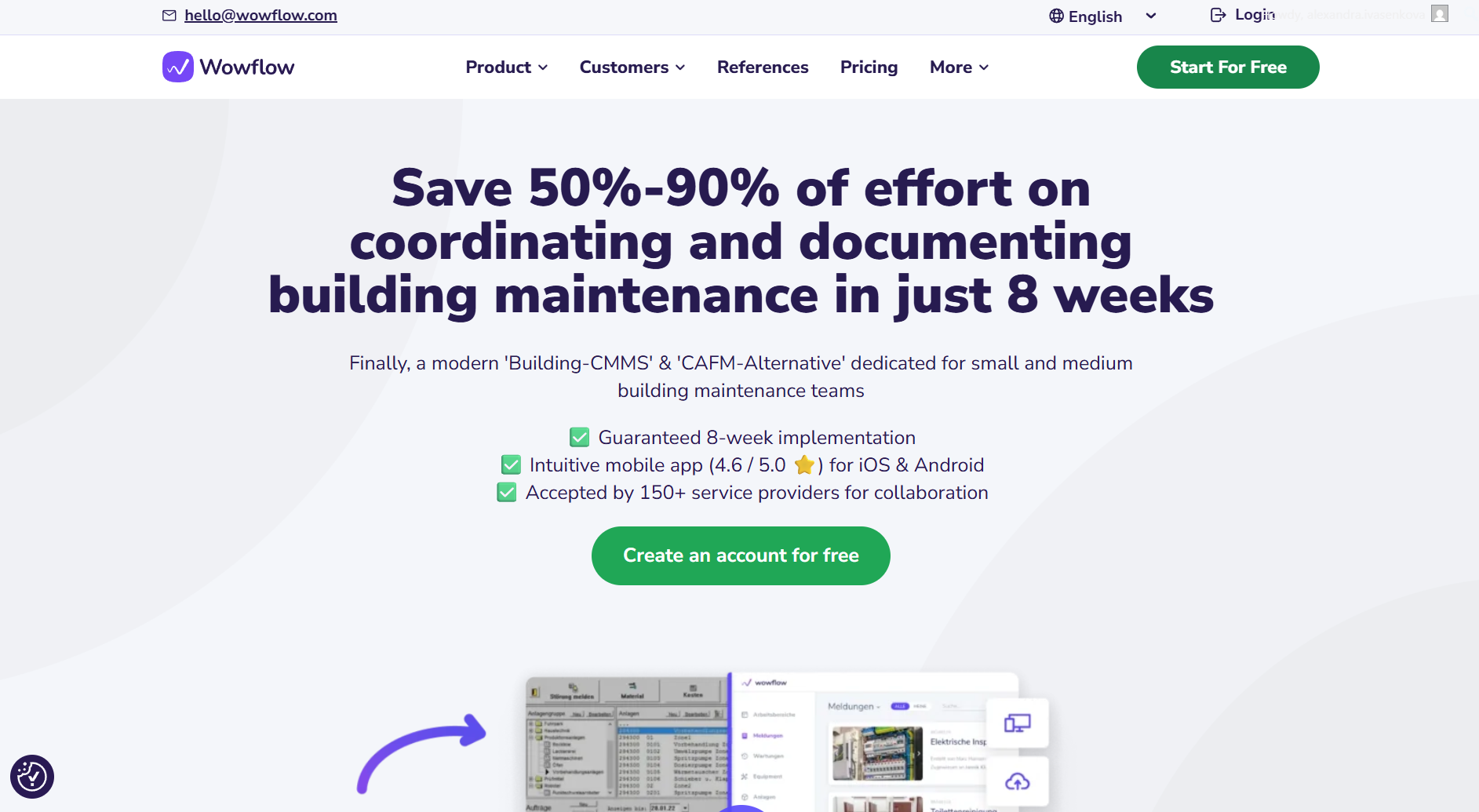
Wowflow - the collaborative CAFM alternative for small and medium-sized teams
- Free, unlimited inclusion of external service providers, with no account or licence required on their side.
- Quick implementation, typically ready for use within two weeks.
- Good price-performance ratio: the user licence starts from €39 per month, with additional licences added as needed.
- A well-rated mobile app that keeps field teams connected to the same system as office-based managers.
- Supports ten languages, including German, English, Polish, Turkish and Romanian.
- A free 14-day trial available directly via the website, with no sales call required.
- Transparent pricing published directly on the website, so you can see costs upfront.
- The platform doesn't cover the full CAFM module set, such as space and area management
- Limited customisation depth and fewer enterprise-grade integration options for very large, multi-country organisations.
Space and area management
Maintenance and order management
✅
Maintenance planner
✅
Asset Management
✅
Device and key management
✅
Energy and environmental management
Letting and property management
Contract and budget management
Founded in 2018 by a team with hands-on facility management experience, Wowflow takes a deliberately different approach to CAFM. Rather than building toward the full breadth of a certified, plan-based system, the platform focuses on the operational and collaborative side of the job: getting internal teams and the external service providers they depend on working from the same system, without friction.
That collaboration model remains Wowflow’s defining characteristic. An unlimited number of external service providers can be added to the platform free of charge, and they receive detailed job descriptions whether or not they hold a Wowflow account of their own.
Wowflow centres on order management and ticketing, asset tracking, and device and key management, with planned maintenance automatically delegated to internal technicians or external service providers. Photo documentation, flexible checklists and forms support day-to-day inspections, while orders can be sent to service providers by email or QR code without requiring an account. Reports can be exported as PDF or uploaded directly to ERP systems.
Target group: Wowflow is best suited to small and medium-sized facility management teams that need to bring documentation, maintenance scheduling and external contractor coordination into one place, without taking on the cost or complexity of a full CAFM deployment.
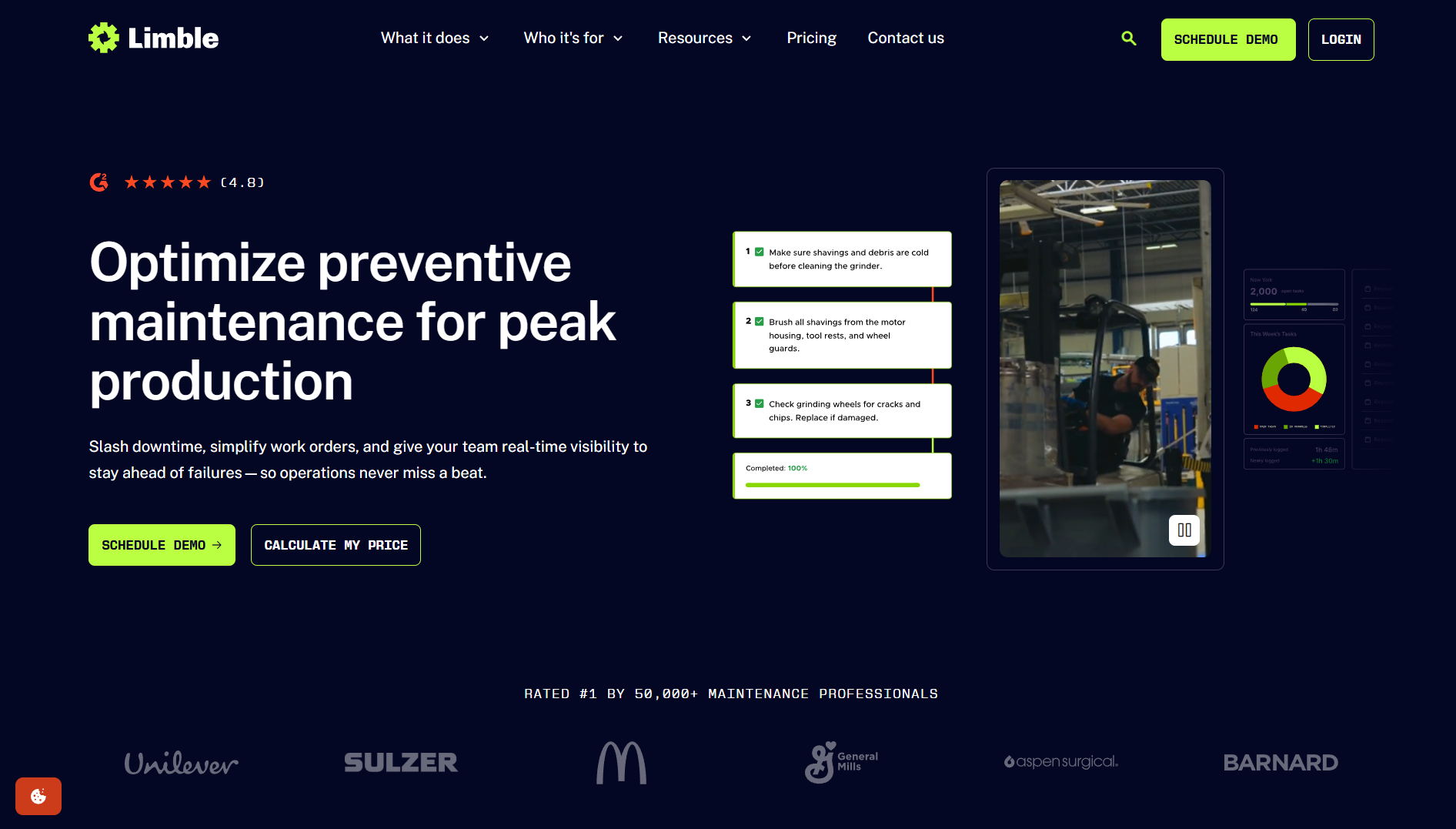
Limble CMMS
- Work order management and preventive maintenance are its core strengths and the features users engage with most.
- Intuitive interface that new field staff can pick up with little formal training.
- Solid asset tracking that keeps location, history, custom fields, and attached documents together in one record.
- A strong reputation among users for responsive customer support and a helpful onboarding experience.
- Does not cover the full CAFM module set, with no space and area management or other core facilities functions.
- Limble does not publish flat per-user rates and routes buyers to a calculator, which makes upfront cost comparison difficult.
- Limble is designed around the internal technician team, so coordinating a network of external contractors is not what the platform is shaped around.
- The entry tier limits advanced analytics to three reports per month, which becomes a constraint quickly for teams that need daily KPI visibility.
Space and area management
Maintenance and order management
✅
Maintenance planner
✅
Asset Management
✅
Device and key management
Energy and environmental management
Letting and property management
Contract and budget management
~
Founded in 2015, Limble CMMS approaches the CAFM software category from a maintenance-first angle. It was built to replace spreadsheets and slower legacy systems for asset-heavy teams, and the whole product is shaped around getting a maintenance department running quickly, with as little configuration and IT involvement as the job allows.
With its user-friendly mobile app and intuitive features, Limble CMMS is easy for non-technical users to adopt quickly.
Limble centres on work order management and preventive maintenance, with unlimited assets, work orders, and an AI-assisted PM builder. Asset lifecycle tracking, spare parts and inventory, vendor and purchase order management, and custom KPI dashboards fill out the platform, though several of these become available only at the mid-tier Premium+ level.
Target group: Limble is best suited to single-site maintenance teams in manufacturing, food production, healthcare, and facilities operations. Teams that need to coordinate a large external service-provider network will find that it sits outside what Limble is built to do.
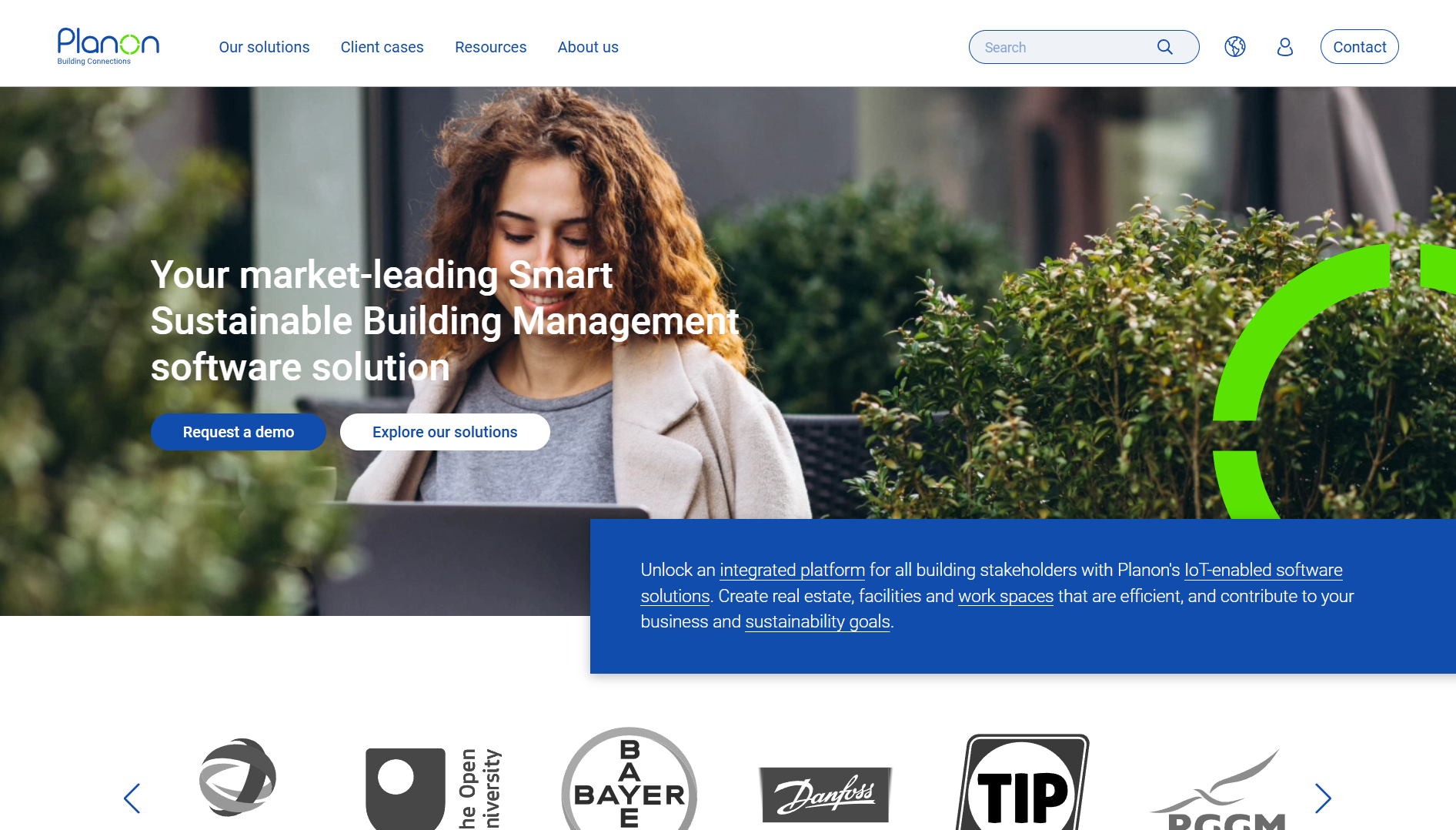
Planon
- Strong sustainability and ESG reporting functionality.
- Extensive customisation possibilities with a very broad range of modules
- Extensive integration with enterprise systems such as SAP.
- The large number of functions can be overwhelming, especially at the beginning.
- The customisation and comprehensiveness increase the cost and duration of implementation, which means extensive consulting is often required.
- It is not possible to test the software via the website, and pricing is not disclosed.
Space and area management
✅
Maintenance and order management
✅
Maintenance planner
✅
Asset Management
✅
Device and key management
✅
Energy and environmental management
✅
Letting and property management
✅
Contract and budget management
~
Founded in 1982, Planon is one of the longest-established names in the international CAFM software landscape and today operates across multiple countries with a workforce in the thousands.
Where a tool like Wowflow narrows in on the operational and collaborative side of facilities work, Planon takes the opposite approach and builds toward breadth, growing over four decades into a full IWMS that connects everyone involved in facilities management across real estate, workplace, maintenance, and sustainability.
The platform covers an extensive set of features and offers enterprise integrations such as SAP. Sustainability and ESG reporting is a particular area of strength, one in which independent analysts repeatedly place Planon among the leaders. Its centre of gravity sits firmly on the real estate, compliance, and sustainability side, so its maintenance functionality, while present, is less specialised than a dedicated software built for heavy manufacturing environments.
Target group: Planon is best suited to large corporations and organisations managing diverse, multi-country property portfolios, particularly those with serious sustainability and compliance reporting obligations. No test account is available via the website.
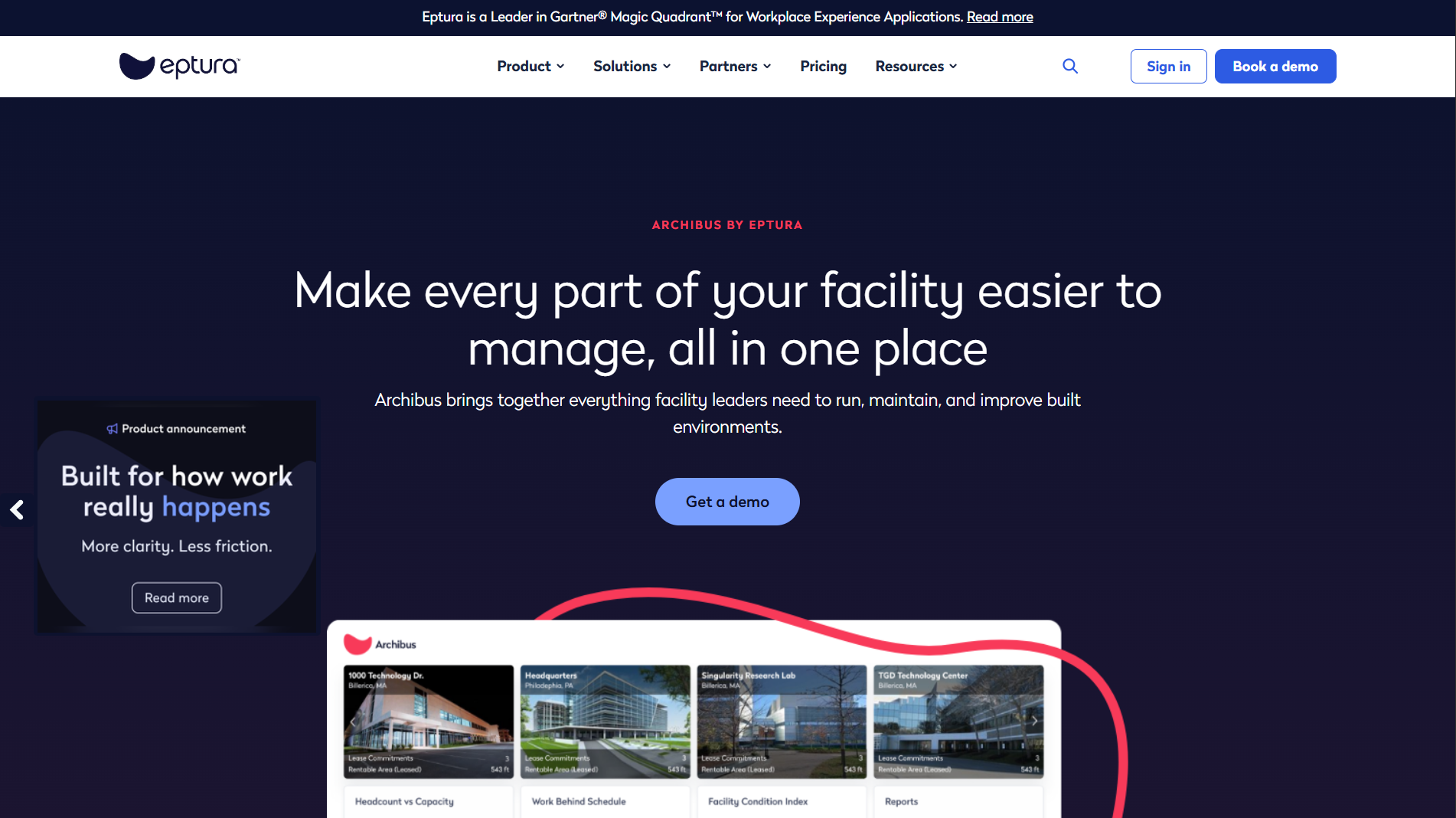
Archibus
- One of the most capable CAFM and IWMS platforms available
- The platform is highly customisable, so it can be shaped closely to specific business processes and workflows.
- Generally rated easy to use, with a web-based, client-friendly interface
- Strong in space and area management
- High cost and considerable complexity, with a steep learning curve
- Implementation is a demanding, consulting-led project
- Reported mobile app ratings are on the lower side
- Upgrades are a recurring pain point, described by reviewers as complicated
- Reviews mention an inconsistent support quality
Space and area management
✅
Maintenance and order management
✅
Maintenance planner
✅
Asset Management
✅
Device and key management
✅
Energy and environmental management
✅
Letting and property management
✅
Contract and budget management
✅
Founded in 1982, Archibus is one of the oldest and most robust enterprise IWMS and CAFM software platforms on the global market. It sits at the maximum-capability end of the spectrum, built to map and manage large enterprise estates, and it is used most heavily in sectors like education, government, and healthcare.
Its recognised strengths include automated workplace reservations and hoteling, a centralised service desk, and strategic space planning, all aimed at simplifying complex workplace management at scale.
That breadth comes with weight. Reviewers and analysts consistently note that cost tends to be high, pricing is not publicly listed, implementation is a specialist project, and ongoing administration typically calls for dedicated expertise.
Target group: Archibus is best suited to large enterprises and facilities engineering teams running highly complex building management, particularly those that want to drive space, assets, and finances directly from CAD and BIM data, and it is most established in North America.
IBM Maximo
- One of the most established enterprise asset management platforms on the market.
- AI and IoT capabilities for predictive maintenance and real-time asset monitoring.
- Extensive compliance and audit-trail functionality for regulated industries.
- Deployment and ongoing administration require experienced consultants or internal specialists.
- The out-of-the-box setup usually needs customisation to fit specific business processes.
- Built as an enterprise asset management platform first, so its space, workplace, and property management is more limited than a dedicated IWMS.
- No self-service trial; access is arranged through IBM directly.
Space and area management
~
Maintenance and order management
✅
Maintenance planner
✅
Asset Management
✅
Device and key management
✅
Energy and environmental management
✅
Letting and property management
~
Contract and budget management
✅
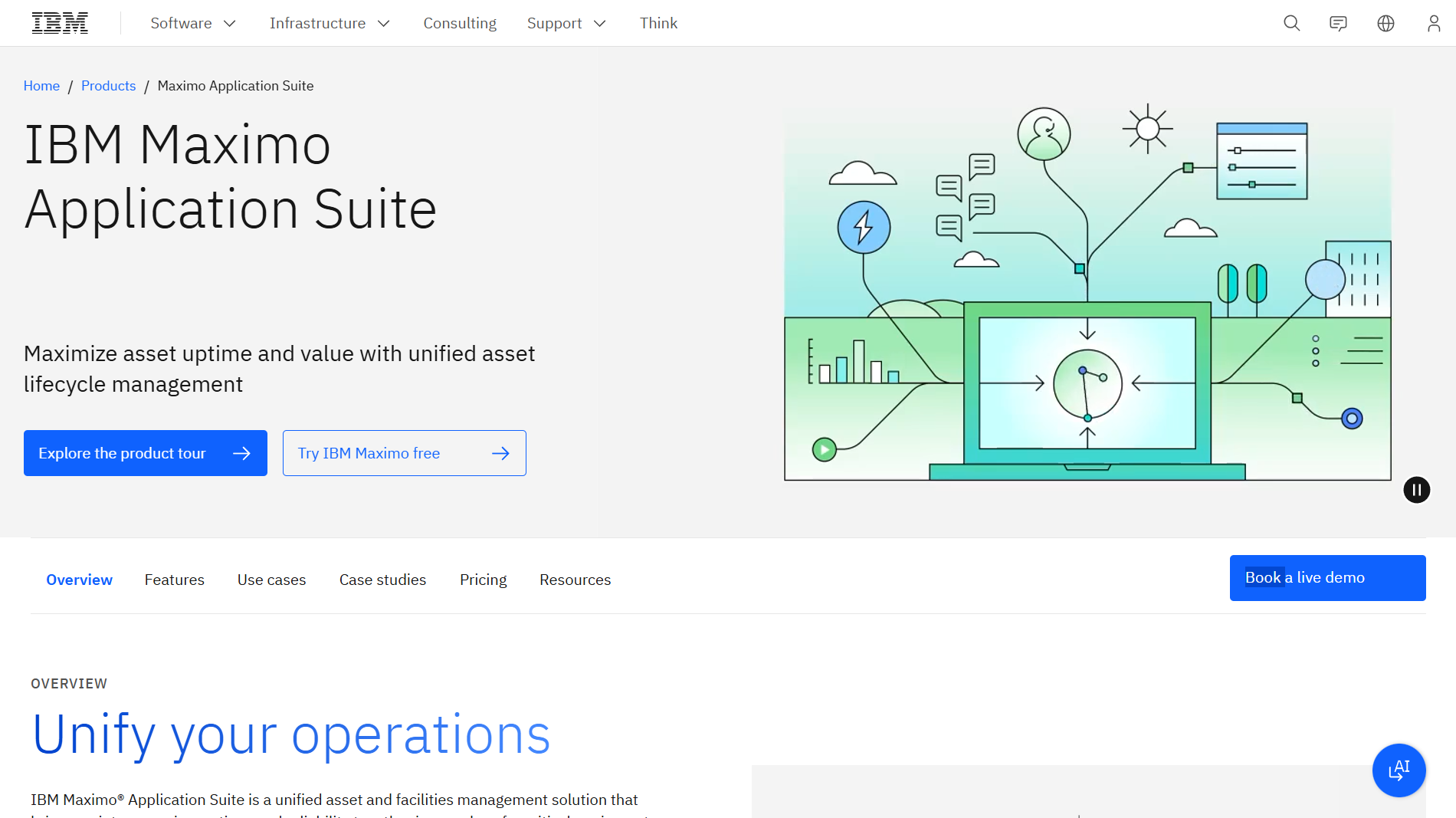
IBM Maximo Application Suite is an enterprise-grade asset and facilities management solution, and within a CAFM software comparison it sits at the asset-management end of the field, combining maintenance management, asset performance management, and AI-powered monitoring in one platform. It is used by organisations managing critical infrastructure across manufacturing, energy, utilities, transportation, and government.
IBM Maximo is widely regarded as one of the most capable platforms for complex, asset-intensive environments. However, users consistently note that this capability comes with a steep learning curve. The out-of-the-box interface requires meaningful configuration to align with specific workflows, and most organisations will need experienced consultants for implementation and administration.
For organisations managing straightforward building operations, Maximo is likely more platform than they need. For those managing critical infrastructure at scale, where asset failure carries significant operational or regulatory consequences, it is a well-proven choice.
Target group: IBM Maximo suits large enterprises, infrastructure operators, and government organisations managing critical assets across complex, multi-site environments where AI-assisted predictive maintenance and compliance documentation are central requirements.
FMX
- Purpose-built for K-12 and higher education, with functions designed around school district operations.
- Interactive, map-based work order and asset visualisation on custom floor plans or geo-based maps.
- Capital planning dashboard for long-term asset and budget forecasting.
- Public-facing request portal lets parents, staff, and community members report issues without an FMX account.
- The education-sector focus means some functions are less suited to general commercial facility management.
- Pricing is not publicly disclosed on the website.
- Public mobile app-store ratings are on the lower side
- Built around sector-specific workflows, so it covers less of the full horizontal CAFM module range than a dedicated IWMS.
Space and area management
~
Maintenance and order management
✅
Maintenance planner
✅
Asset Management
✅
Device and key management
Energy and environmental management
Letting and property management
~
Contract and budget management
~
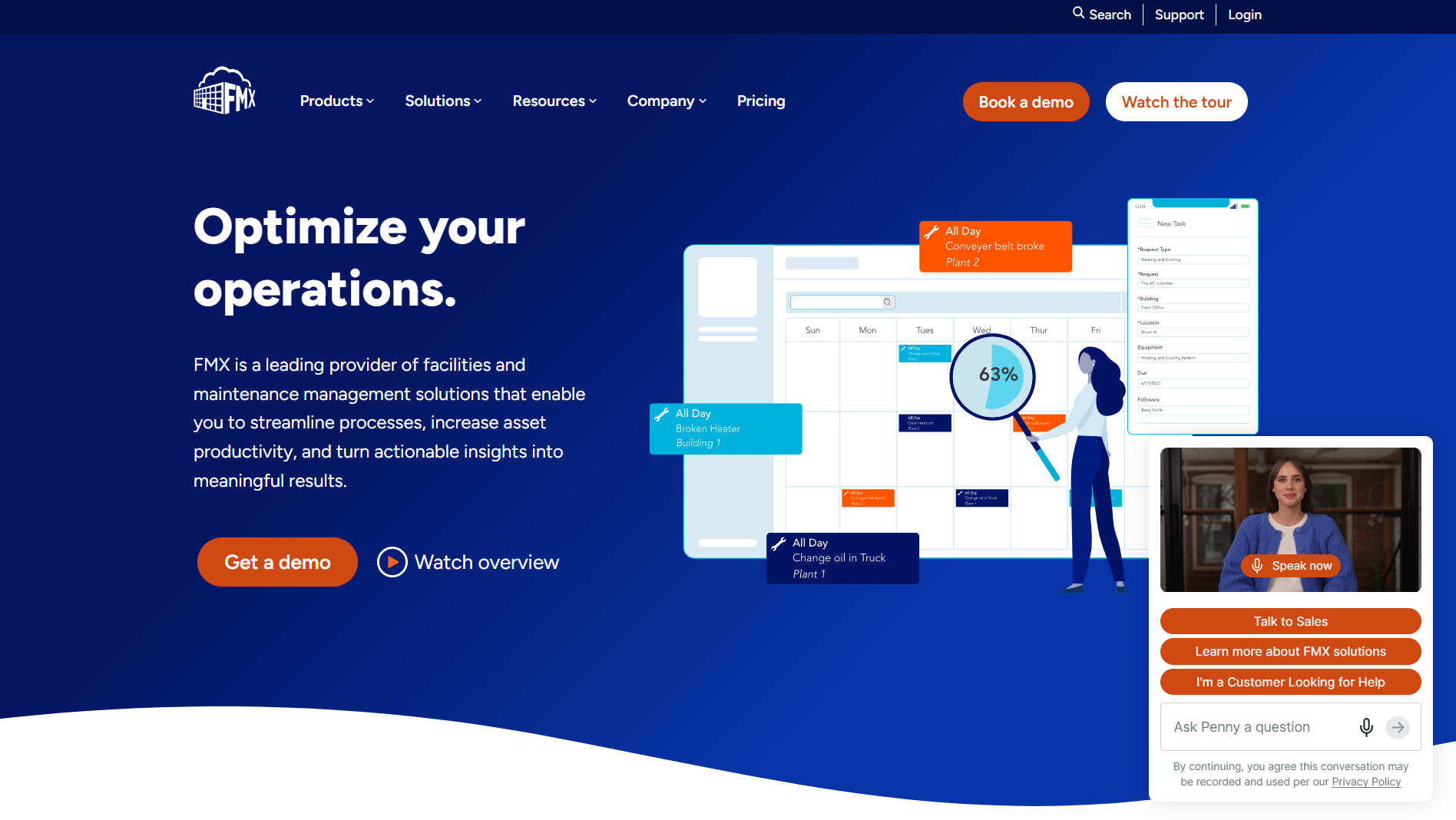
FMX is a cloud-based CAFM software and CMMS platform designed primarily for K-12 and higher education institutions, along with state and local government organisations.
The platform centralises work order management, preventive maintenance, asset tracking, fleet management, IT asset management, capital planning, event management, and rental and reservation management.
Outside the education and government sectors, FMX has a more limited track record, and organisations in commercial facility management may find that the platform’s feature set reflects its sector focus more than their own requirements.
Target group: K-12 school districts, higher education institutions, state and local government organisations, and other public sector or community-facing facility management teams.
Facilio
- Modern, cloud-native CAFM software and "Connected CMMS" built around IoT, AI, and building automation.
- Consolidates multi-site portfolios into one dashboard, unifying mixed building-automation hardware.
- Strong energy and sustainability management with real-time tracking, sub-metering, and anomaly detection.
- Condition-based maintenance that triggers work orders automatically from sensor or HVAC alarms.
- Value depends heavily on building tech maturity; older or low-tech estates can't use its best features.
- Some reviewers report a less polished UI and mobile experience, including occasional crashes.
- Relies on secondary software (MRI, Yardi) for core lease and tenant management.
- Pricing skews toward multi-site portfolios and is not published
Space and area management
✅
Maintenance and order management
✅
Maintenance planner
✅
Asset Management
✅
Device and key management
✅
Energy and environmental management
✅
Letting and property management
~
Contract and budget management
~
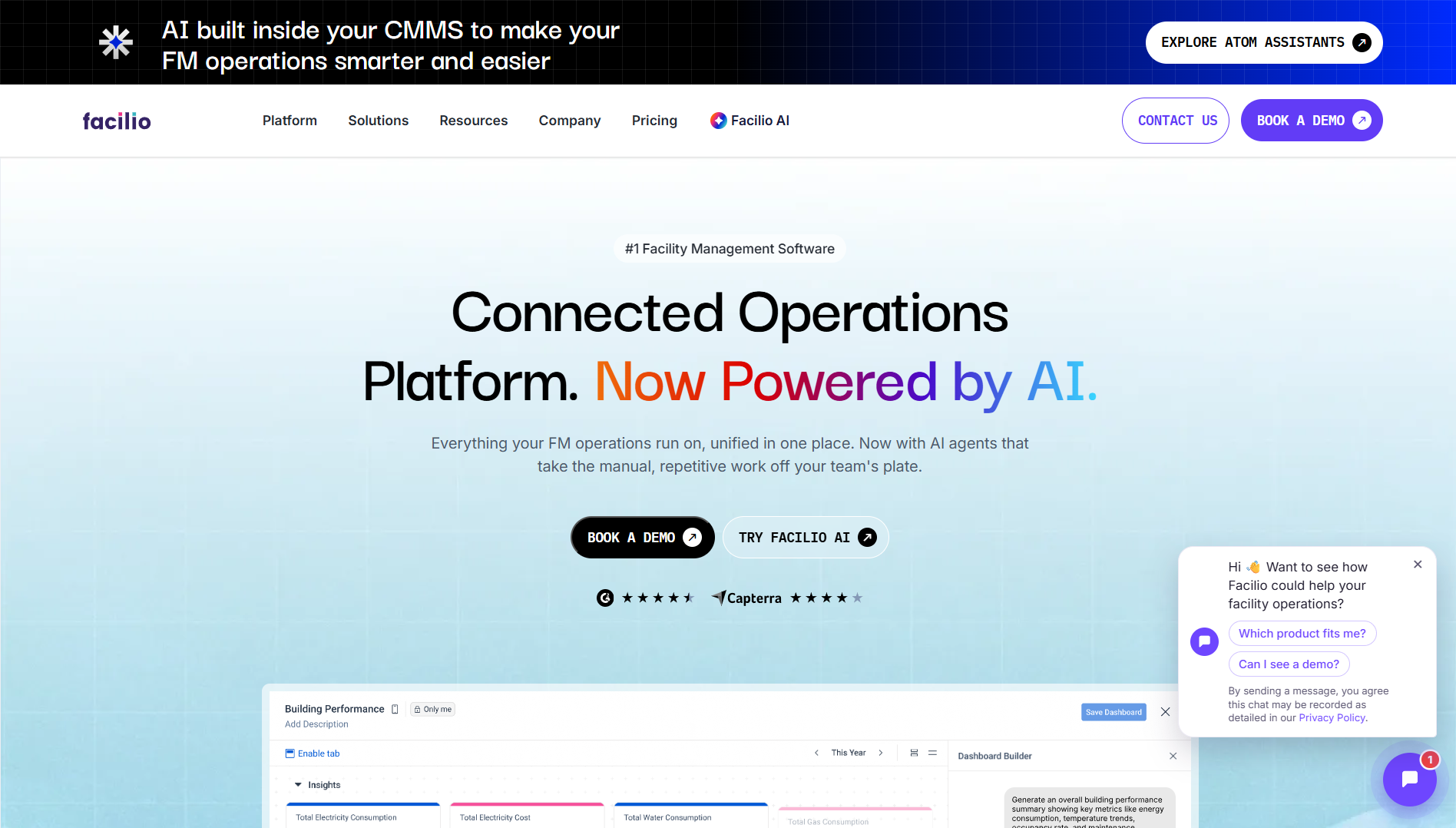
Facilio represents the modern end of the CAFM software market built explicitly around IoT, artificial intelligence, and building automation. Marketed as a “Connected CMMS/CAFM,” its aim is to turn a portfolio of buildings into a data-driven, partly autonomous operation by plugging straight into the physical systems those buildings already run on.
Facilio ingests real-time telemetry to score asset health, run fault detection, and dispatch work orders automatically when a sensor or HVAC alarm fires. It extends CAD and BIM into digital-twin territory too, linking 3D building models to live data streams.
Its main limitation is structural. The platform’s most valuable capabilities depend on a building already having modern BMS, smart meters, and IoT infrastructure in place, and for core lease and tenant management it leans on integration with dedicated property software. Energy and environmental management, by contrast, is a particular strength.
Target group: Facilio is best suited to owner-operators and FM service providers managing multi-site commercial real estate portfolios that already run, or are investing in, modern building automation and IoT infrastructure.
Summary: Choose the Right Solution for Your Requirements
There is no single correct answer when it comes to choosing CAFM software. The right choice depends on your organisation’s size and complexity, along with the specific operational problems you’re trying to solve.
For small and medium-sized teams that need to bring documentation, maintenance scheduling, and contractor coordination into one accessible system, Wowflow is a strong starting point. It fits best where the biggest day-to-day challenge is coordinating a fragmented network of external service providers, not running maintenance in-house. Limble CMMS serves a related need in the same category, but its centre of gravity is frontline technician adoption inside a single organisation.
For large, established enterprises with complex, multi-country real estate portfolios, Planon and Archibus represent two long-standing approaches to the same problem, with Planon’s particular strength in sustainability and lease compliance and Archibus’s strength in government and regulated-sector deployments. IBM Maximo sits alongside them as the deepest option for organisations managing genuinely critical, asset-intensive infrastructure, where AI-assisted predictive maintenance and audit-grade compliance are not optional extras.
FMX and Facilio represent a newer generation of providers, each built around a specific gap in the market instead of broad horizontal coverage: FMX for the very particular budgeting and scheduling needs of education and public sector organisations, and Facilio for commercial real estate teams looking for a more modern, AI-native alternative to legacy IWMS platforms.
How we selected and evaluated the software
We aimed to make our comparison as fair and transparent as possible. However, like any market overview, it reflects our methodology and experience. To help you interpret the results, we want to be transparent about the scope and limitations of our evaluation.
1. Our perspective
This comparison was created by the team behind Wowflow. Before developing software, we worked in facility management ourselves, which influences how we evaluate CAFM solutions. We weigh usability and day-to-day operational efficiency heavily, and we care a lot about whether a product justifies its cost. While we have applied the same evaluation approach to every product, readers should be aware of this perspective.
2. Software selection
We chose a representative group of products, drawing on our own market research and years in the industry, along with what we hear directly from customers. The aim was to include both well-established providers and newer solutions that take genuinely different approaches to facility management, so the list isn’t skewed toward one type of tool. We chose a representative group of products, drawing on our own market research and years in the industry, along with what we hear directly from customers. The aim was to include both well-established providers and newer solutions that take genuinely different approaches to facility management, so the list isn’t skewed toward one type of tool.
CAFM software evolves continuously. Features, pricing, and product offerings may change after publication. If you notice any inaccurate or outdated information, we welcome your feedback at marketing@wowflow.com.
Module overview: Functions and focus of all modules
In this section, you will learn more about the various functions and areas of responsibility of the individual modules.
- 2D/3D floor plans
- Spatial planning
- General space management
- Workplace management
- CAD connection
- Reservation management
- Occupancy planning
- Relocation management
- BIM software integration
- Reactive maintenance
- Inspection and coordination of work orders
- Photo documentation
- Ticketing
- Project management
- Waste management
- Fault message management
- Checklists
- Recurring work
- Calendar planning etc.
- Cleaning management
- Winter service
- Green space management
- Maintenance of the facilities in the building
- TGA/Technical plant management
- Dynamic asset management such as equipment and keys
- Device management
- Key management
- Inventory management
- Inventory
- Tracking and management of energy and sustainability aspects of the building
- Energy management
- Environmental management
- Energy controlling
- General accounting
- Budgeting
- Global cost tracking for the building and contracts with service providers
- Budget management
- Contract management
- Budget management
- Cost tracking
- Contract management & SLA
- Operating cost accounting
- Management of rental contracts
- Debt collection
- Rental contract management
- Letting management