This article was revised on 08.01.2026 and checked for up-to-dateness.
Whether it’s coordinating service providers, ensuring operational safety or planning investments, building managers have their hands full. Keeping everything organized can be a challenge. Fortunately, modern building maintenance software offers digital support that makes these tasks easier.
But which tool is best suited to your individual needs and specific tasks? Our in-depth analysis of building maintenance software provides you with the answer. Based on our market experience, we have identified seven providers that simplify day-to-day tasks and decisions.
The most important facts at a glance
- Building maintenance software supports building managers in structuring processes, standardizing maintenance and creating transparency about tasks and system statuses.
- In our comparison, we present seven established solutions and show which requirements the individual systems are particularly suitable for.
- A clear division into different software products such as CAFM, CMMS or IWMS makes it easier to select the right solution for individual building structures.
These solutions will be important in 2026: Selection of building maintenance software
In our comprehensive comparison, we focus on seven software products that cover the most important tasks of modern building management and are well established on the German-speaking market:
- Wowflow
- Planon
- Net House Software
- Facility24
- Wave Facilities
- eTask
- VertiGIS
Although the software products have some similarities, they differ in their technical orientation and their specific functions to cover the different requirements of building managers.
This selection is based on many years of market experience and aims to present tools that offer real added value in the day-to-day work of building managers and service providers.
To make the selection even easier, the following overview helps to clearly assign software solutions to the respective requirements:
- Wowflow is particularly suitable when fast operational workflows, mobile work processes and high user acceptance are important.
- If a comprehensive, certified overall system is required for large real estate portfolios, Planon or eTask offer the right structures.
- If the focus is on technical building processes and mobile data collection, Net-Haus is a suitable option.
- If you are looking for a modular CAFM system with a wide range of functions, Facility (24) or Wave Facilities come into consideration.
- If spatial data, map views or GIS-based control play a central role, VertiGIS FM is a suitable solution.
Let’s now take a closer look at the individual platforms:
Wowflow - Modern building maintenance software
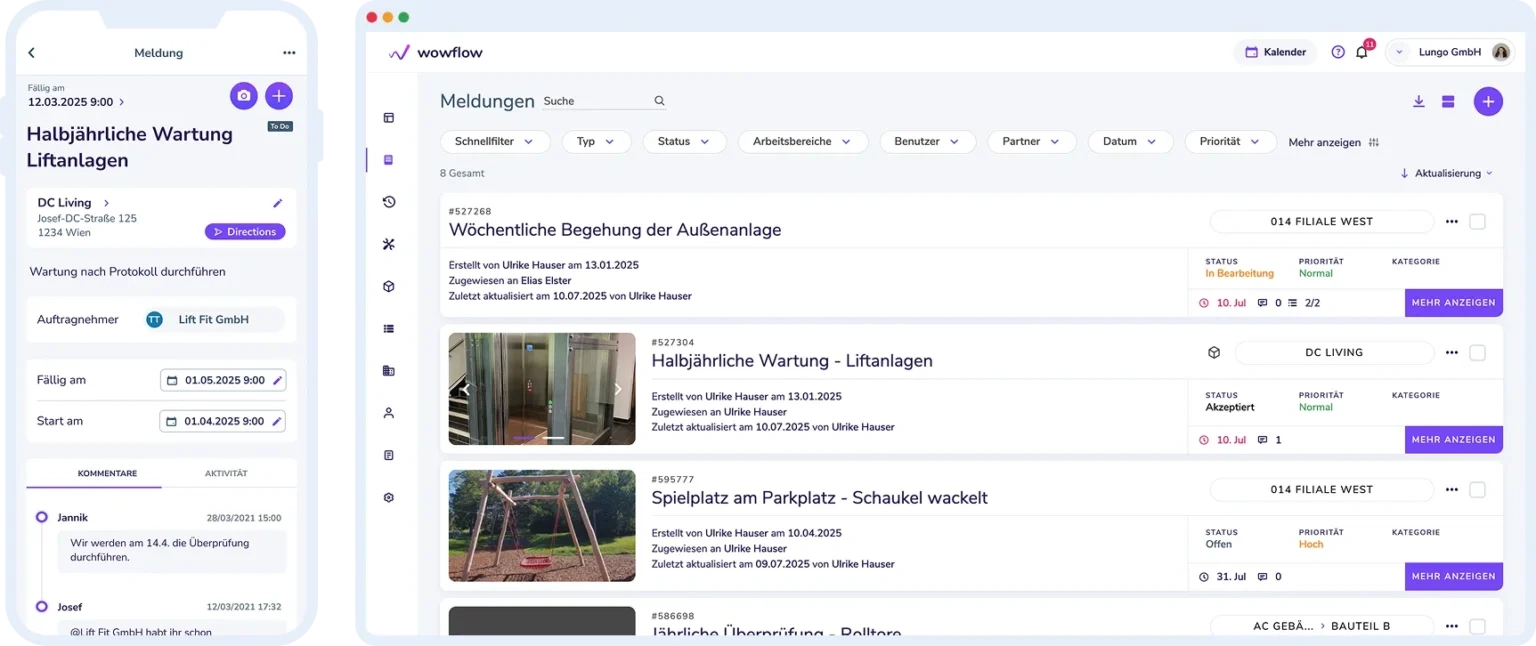
Wowflow is a modern, operationally oriented building maintenance software that deliberately sets itself apart from classic plan-based CAFM systems. The aim is to offer simple solutions that work smoothly.
Wowflow focuses on making daily work processes in building operations simple, fast and mobile controllable. The software is used by managers and field service teams and is available on all devices. In addition, the selected functions and modules are continuously developed further.
Wowflow allows you to prioritize, assign and track tasks in order to make optimal use of resources. To do this, it offers photo documentationseamless email integration and an intuitive, highly rated app. Orders can be sent via QR code or email, so that service providers can be integrated without additional effort – even without a Wowflow account.
There is an integrated calendar for planning maintenance tasks. Other functions include an overview of lost devices and integrated key management. key management.
Thanks to its ease of use, it offers one of the shortest implementation times on the market and is ideal for organizations that require pragmatic, ready-to-use building management software.
Main functions:
- Order management and ticketing: Central management of all projects, including prioritization, status monitoring and real-time communication.
- Asset management: Assets can be recorded via an app to create maintenance plans, for example.
- Device and key management: Transparent control and tracking of loaned items.
- Maintenance planning and servicing: Automatic delegation and monitoring of planned maintenance tasks to internal technicians or service providers.
- Photo documentation and inspection: Precise recording of damage, work progress and inspection results, including comments and checklists.
- Service provider platform: Sending orders to the relevant service providers by e-mail or QR code.
- Checklists and forms: Flexible creation for inspections.
- Analytics and reporting: Automated reports on buildings, tasks or service providers can be created with just a few clicks and saved as PDF files or uploaded to the ERP system.
Advantages:
- Fast implementation: Wowflow is ready for use in the company after two weeks – less time than classic CAFM systems.
- One of the most affordable software products with transparent and flexible pricing: The Manager license costs from 99 euros. Additional licenses can be booked if required.
- 14-day free full access enables real tests during operation.
- High user acceptance: The mobile app has predominantly positive ratings in the app stores (Google: 4.2, Apple: 4.4) and a usage rate of up to 90% in daily use.
- The intuitive app covers all the functional areas contained in the software.
- Ten different languages are supported, including German, English, Polish, Turkish and Romanian.
- QR codes can be created for buildings or systems to automatically record maintenance requests in Wowflow.
- External service providers can be integrated on the platform at no additional cost. They do not even need a Wowflow account, which means that the acceptance rate is almost 100 percent.
- Email integration supports automatic synchronization of messages with Wowflow tasks so that everything is stored in one place.
- A highly praised support team that treats every customer as a real person and not just a ticket number.
Disadvantages:
- Wowflow does not have CAFM certification. One reason for this is that there are no software modules such as spatial planning and energy management.
- Hosting takes place in the cloud. There is no on-premise version. However, a private cloud solution can be set up.
Wowflow is a modern building management software that focuses on the core processes. This makes it quick to implement and intuitive to use. The focus is on mobile working with smartphones and tablets.
Wowflow offers a free 14-day trial access and comprehensive information on the website.
- For companies looking for lean software with a top price-performance ratio.
- Can be operated in the browser or via mobile app.
- Trusted rating: 4.7 (90 reviews)
Planon
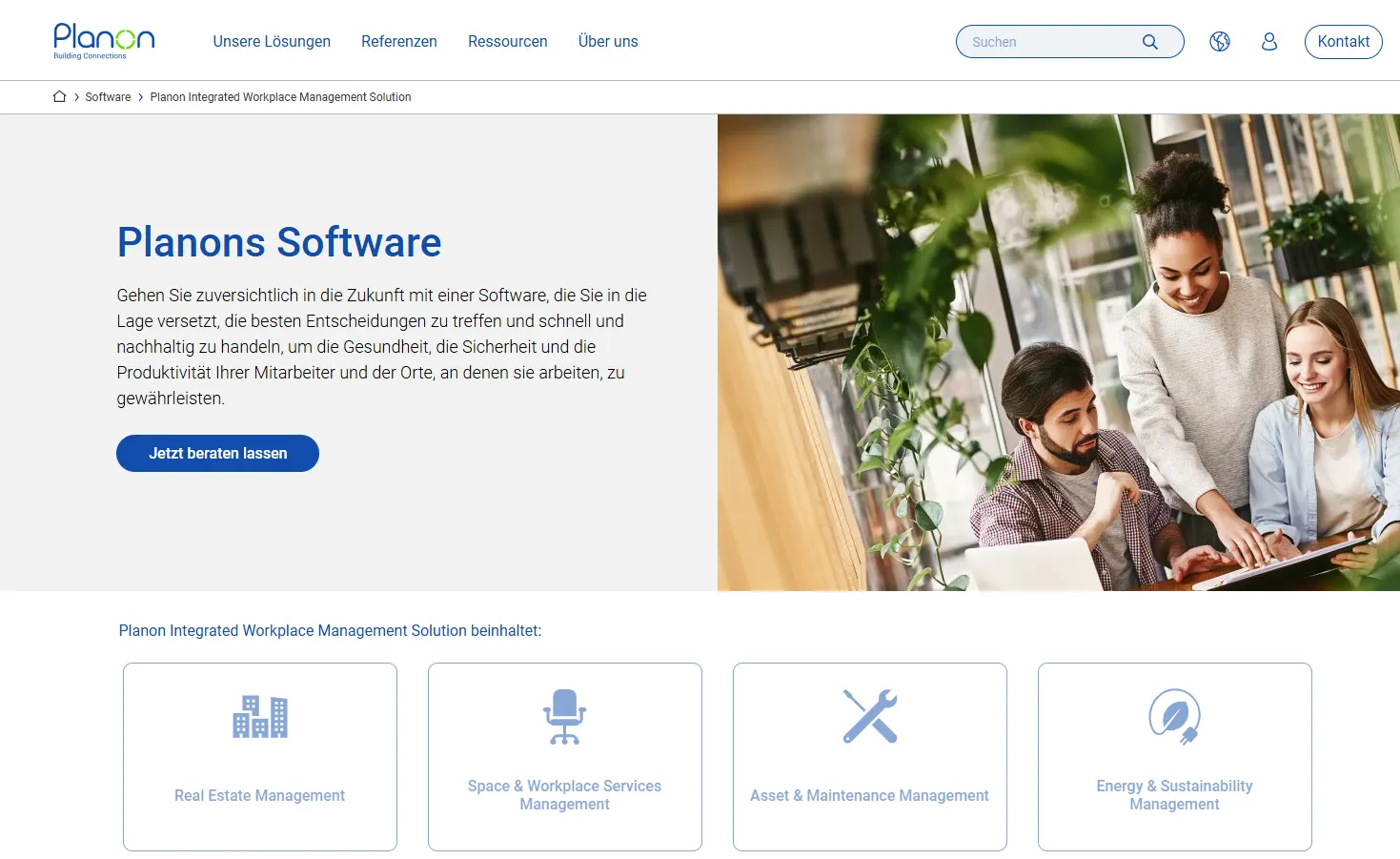
Planon is one of the world’s largest providers of building maintenance software and IWMS solutions. The company operates sites in 16 countries and employs over 1,000 people. The main objective is to break down data silos and create a central, integrated information platform that enables all parties involved in building operations to work together.
The Planon platform covers strategic real estate management, workplace services, technical maintenance and sustainability management. The solution therefore goes far beyond conventional CAFM software and is used by over 3,250 customers worldwide.
Main functions:
- Space & Workplace Services Management: Planning, control and optimization of workplaces, space utilization and occupancy strategies.
- Asset & Maintenance Management: Ensuring regular operation over the entire life cycle of the systems.
- Real Estate Management: Central management of the real estate portfolio, including rental contract management and cost control.
- Energy & Sustainability Management: recording and evaluation of energy consumption and carbon footprint.
- Service management: helpdesk, ticketing and service level control to improve operational processes.
- Mobile & IoT integration: use of real-time data on room occupancy, temperature, energy or air quality automatically in the system.
Advantages:
- A central database, the “single source of truth”, which reliably brings together information from all areas of building management.
- SAP Contract and Lease Management Support
- The comprehensive software modules are well coordinated and cover almost all aspects of building management with a single tool.
- The software is GEFMA 444-certified.
- Option to choose between a cloud and an on-premises version.
Disadvantages:
- The large number of functions leads to a high level of complexity, which requires considerable training at the beginning.
- The system is cost-intensive and requires a long implementation phase, during which support from a Planon consultant is necessary.
- It is not possible to carry out a functional test of the software on the website.
- The pricing model is not communicated publicly, which means that no direct cost estimate is possible.
- High focus on desktop applications, which is reflected in an outdated app for smartphones and tablets.
Planon is the global market leader and offers a wide range of IWMS and CAFM functions. The basis for this is the Planon platform, which enables company-specific customization of the tools.
It is not possible to request a test account via the website.
- Particularly suitable for global corporations and companies with a wide range of building management tasks.
- The software can be operated locally or in the cloud.
- Trusted rating: 3.3 (49 reviews)
Net-Haus (hausmanager and TechnikerApp)
Net-Haus is an established provider of building maintenance software with over 25 years of market experience. With the web-based Hausmanager solution (2004) and the TechnikerApp (2008), the company is primarily aimed at technical building management companies. This year, Net-Haus was acquired by the Polish CAFM provider Singu, which should further strengthen its innovative power.
According to the company, more than 400 facilities are using “Hausmanager” and around 4,500 technicians work with the TechnikerApp every day. The software primarily supports technical building management and offers functions for job planning, communication and service documentation.
Main functions:
- Order management and ticketing: centralized creation, processing and assignment of tasks with status tracking
- System management: Assignment of systems to rooms or buildings, including QR codes for mobile information retrieval and documentation.
- Consumption meter: Recording of meter readings via a mobile app, including history and evaluations.
- Time recording: Documentation before working hours according to employees, tasks or projects.
- Evidence and protocols: A PDF document serves as proof of performance and is filed on a task-related basis.
- Quality control (optional): The quality of the services provided can be checked using individual checklists.
- Checklist templates according to VDMA 24186 (optional): The list compiled by the German Engineering Federation helps to optimize maintenance.
- Invoice creation (optional): Individual invoices for services rendered as well as collective invoices for service providers can be created with just a few clicks and sent by e-mail.
Advantages:
- A 30-day trial period to test the system risk-free.
- The solution can be operated both in the cloud and locally. This means that different data protection, service level and billing requirements can be met.
- The optional models enable step-by-step adaptation to individual requirements.
- hausmanager offers a variety of interfaces to other programs so that information is transferred seamlessly and does not get lost.
Disadvantages:
- User reviews occasionally criticize slow response times in support and delayed troubleshooting.
- The design of the web application and the app sometimes looks outdated.
- Following the takeover by Singu, it is unclear how the company will develop in the coming years.
- Net-Haus is positioned in the field of technical building management. Typical CAFM software modules such as room planning and CAFM certification are missing.
- No prices are stated on the website.
Net-Haus is software designed for technical building management. The scope of services can be extended with optional features such as invoicing.
Net-Haus offers a 30-day trial period for the software. There is also the option of a free online presentation.
- For building managers, janitor services, property managers and social services.
- Available in the browser, in the mobile app or as a locally installed program.
- Trusted rating: 3.7 (16 reviews)
facility (24)
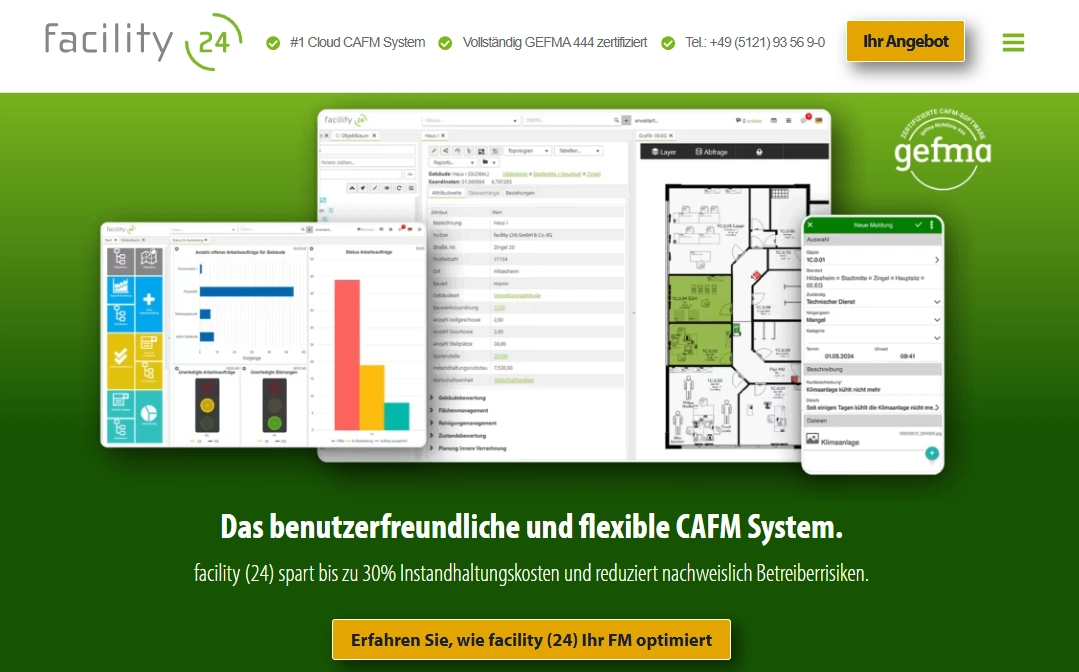
According to the manufacturer, Facility (24) is one of the most widely used cloud CAFM systems in the DACH region. The software covers a wide range of typical expectations in building management and is GEFMA-certified.
The solution has a modular structure: The cornerstone is the “Space, cleaning and property management” module. Its functions are designed to support medium-sized companies in managing their properties. Building on this, there are further specialist modules. The system can be flexibly expanded and tailored to the various needs of a company.
Main functions:
- Space, cleaning and property management: Overview of all properties with 360° views, map integration and property-specific data.
- User Help Desk module: Central recording and processing of faults and inquiries, including support for mobile reporting via an app.
- Maintenance / TGA module: Mapping of all maintenance processes, including calendar view, times, material consumption and documentation.
- Energy management module: Planning, control, recording of meter readings and monitoring of energy consumption.
- CAD component: Precise planning and evaluation of rooms and areas by type of use.
Advantages:
- facility (24) is GEFMA 444-certified and offers a wide range of CAFM features.
- According to the company, the software is implemented in less than ten weeks in 80% of cases – an above-average speed.
- The software offers interfaces to SAP, ERP, GLT, DMS and other systems, which guarantees a seamless flow of information.
- The modular structure enables flexible expansion that adapts the license costs to the actual usage.
- Our long-standing market presence ensures experienced advice and reliable practical relevance.
Disadvantages:
- The low number of app downloads indicates that mobile use is less established on the market or less intuitive.
- As with other GEFMA-certified software, the implementation and customization costs are higher.
- Local installation is not possible, which restricts companies with strict IT requirements.
facility (24) is a cloud-based software with an on-demand service that ensures faster implementation. Thanks to its modular structure, the CAFM system can be flexibly adapted to different requirements.
A free trial account can be requested via the website.
- For companies with many properties and assets, such as hospitals, financial service providers and supermarkets.
- Limited use on desktop and as a mobile app.
- Trusted rating: 5.0 (14 reviews)
Wave Facilities
Loy & Hutz is a software manufacturer from Giessen that started out in the mid-1980s with a program for controlling medical devices in hospitals. Today, Waveware forms the technological basis of the company. It is a modular platform that can be used to create and adapt individual applications without programming knowledge. Wave Facilities is therefore a flexibly configurable building management system with over 2,700 function modules.
Main functions:
- FM basis: Recording and structuring of all buildings, rooms and facilities as well as the assignment of dates, events and projects.
- Room & Space: Space management categorized according to DIN 277, can be graphically recorded and economically optimized.
- Ticket: Registration, bundling and processing of faults and inquiries.
- Maintenance: Planning, management and optimization of measures with the maintenance module.
- REG-IS: Automated integration of current legal requirements.
- Privacy Suite: Tools for complying with data protection regulations, including GDPR-relevant processes.
Advantages:
- Loy & Hutz’s long history and cooperation with large companies ensure extensive practical experience.
- The modular design principle facilitates customization without the need for programming.
- The GEFMA 444 certification confirms the broad scope of CAFM functions.
- The software offers a modern user interface for desktop and mobile devices.
- waveware offers a variety of interfaces that enable flexible integration into different IT landscapes.
Disadvantages:
- Due to the great design freedom, higher costs are incurred for consulting, training and implementation.
- The software is not available as an on-premise version.
- The large number of selection and customization options can overwhelm inexperienced users.
Loy & Hutz is one of the leading CAFM software providers in the DACH region. Their platform solution waveware supports functions that allow the user interface of the modules to be customized.
A demo version and further information material can be requested via the website.
- For companies in various industries that want to adapt their processes quickly and individually.
- It can be used with a PC, laptop, tablet and smartphone.
- Google rating: 4.9 (11 reviews)
eTask
eTask is a provider of building maintenance software that develops several specialized products for real estate operations. In addition to the CAFM program, the portfolio also includes inventory and commercial management systems.
A BIM (Building Information Modeling) methodology based on the open IFC standard is natively integrated into the software. The solution has a modular structure and can be flexibly adapted to different organizational needs – from technical maintenance to space and cleaning management to relocations or fleet processes. The software is GEFMA 444-certified.
Main functions:
- Maintenance: Creation of precise maintenance plans with scheduling, task transfer, documentation and tracking.
- Asset management: Overview of movable and immovable assets as well as their locations and values.
- Building Information Modeling (BIM): Use of a digital twin for early planning and better visualization of operating processes.
- Cleaning management: planning, tendering, monitoring and reporting of cleaning services.
- Relocation management: Support for the coordination of large relocation projects with the help of centralized workflows.
- Fleet management: control of online vehicle bookings, leasing contract data and inspection dates.
Advantages:
- The software is available as an on-premise and cloud version.
- eTask is GEFMA 444-certified and includes a wide range of CAFM functions.
- The solution can be seamlessly integrated into ERP systems such as SAP.
- eTask is modular, so that the software can be adapted to individual requirements and expanded step by step.
- Thanks to BIM integration, building managers have a single source of truth.
Disadvantages:
- Some users find the user interface less intuitive or visually outdated compared to modern cloud-based systems.
- The large selection of modules can be overwhelming for new users at the beginning and require training.
- As with other GEFMA-certified platforms, implementation and acquisition costs are often higher.
- No free trial version is offered via the website.
eTask is one of the few CAFM software solutions to provide a BIM function. It forms the basis for the visualization of processes in facility management.
eTask does not offer a free trial version on the website.
- For corporate groups and medium-sized companies in Germany and Austria.
- Provision in the cloud or on your own servers.
- Google rating: 4.8 (5 reviews)
VertiGIS FM
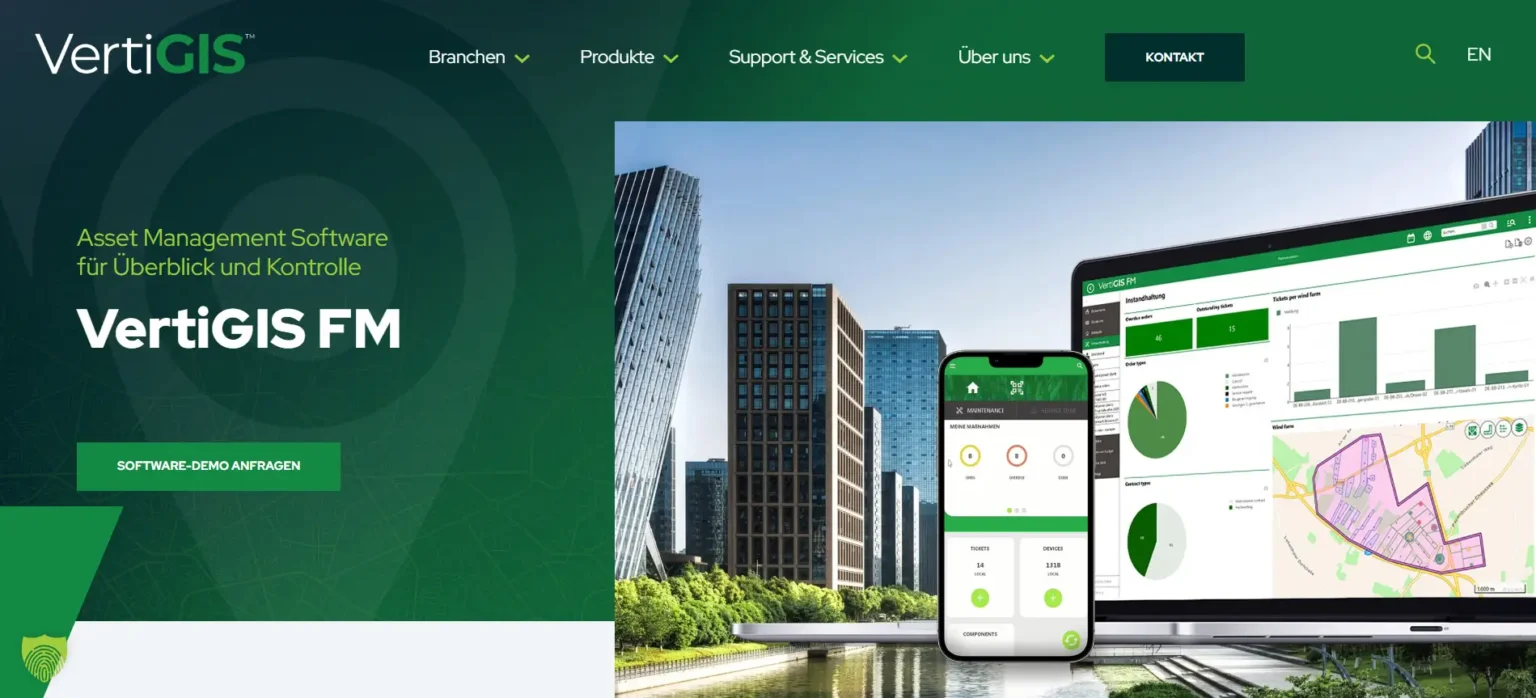
VertiGIS FM is a comprehensive web-based CAFM software for technical and infrastructural building management. The solution places a strong focus on spatial data and geographical information visualization (GIS). This allows objects to be precisely localized on maps and processes to be controlled remotely.
VertiGIS FM is used in numerous industries, works with more than 80 organizations and supports them in the administration of buildings, facilities and infrastructure.
Main functions:
- Integrated maps & plans (GIS/CAD/BIM): Visualization of objects on interactive maps. Precise localization, area analyses and map-based process control.
- Real-time monitoring & IoT integration: Integration of IoT sensors, continuous monitoring of performance data, reporting and automatic alerts in the event of deviations from the forecast.
- Offline mobility: recording of damage on the move and real-time synchronization on site thanks to the offline functions of the mobile app.
- Inventory and asset management: Creation of a complete, precise and digital representation of buildings, rooms, facilities and inventories.
- Cleaning, key and reservation management: planning of cleaning areas, calculation of service costs as well as budget and key control.
- Energy and consumption management: creation of centralized energy reports through automated data import, integration of smart meters and analysis of energy and CO₂ consumption.
- Management of green spaces and tree registers: GPS-based maps make it easier to track trees, identify hazards and prioritize maintenance work.
- Fault management: damage assessment, task assignment and management of spare parts and stocks.
- Analysis: Detailed evaluations and clear dashboards on operating costs, energy consumption, maintenance status and contract data.
- System integration: Seamless connection to existing IT systems such as SAP, GIS, BIM or DMS, enabling automatic data synchronization without media disruptions.
Advantages:
- Wide range of functions and modules that reliably cover typical CAFM expectations.
- The solution can be adapted to individual processes down to the last detail with VertiGIS Studio.
- Map and planning data are strongly integrated, which improves the spatial overview.
- Web-based architecture with versatile interfaces for existing system landscapes and seamless connection to different systems.
Disadvantages:
- Originally developed with GIS in mind, which is reflected in the operating logic and user guidance.
- Higher implementation costs due to the high proportion of individual configurations.
- The mobile app must be set up independently, which means additional work.
VertiGIS FM is a comprehensive CAFM and asset management system with a strong GIS focus. The software covers a wide range of functions for buildings, facilities, infrastructure, energy, contracts and green spaces and can be flexibly adapted to individual processes using VertiGIS Studio.
A free demo is available on the website.
- For municipalities, public institutions, infrastructure operators, industrial companies and real estate management companies.
- Fully web-based with mobile use and offline functions.
- Trusted rating: 3.5 (25 reviews)
(glassdoor.com)
Types of building management software
Software products for building management are all-in-one platforms and therefore planning, administration and communication tools. Users can prioritize and delegate their tasks, streamline and document maintenance processes and proactively develop and implement maintenance strategies.
Despite these similarities, there are considerable differences between the individual tools. The following distinction has been established for systematization purposes:
CAFM (Computer-Aided Facility Management)
Building mainenance software like our CAFM software overview offers comprehensive functions for holistic building management. Both technical and commercial, infrastructural and administrative tasks are covered – for example, space management, room and contract management, energy controlling and the coordination of service providers.
CAFM software solutions can be certified by the German Association for Facility Management (GEFMA). They are tested by experts using a fixed catalog of criteria.
CMMS (Computerized Maintenance Management System)
CMMS focuses on the technical maintenance of systems and buildings. Typical functions include maintenance planning, fault management, repair and spare parts management and the documentation of maintenance measures. CMMS is often a component of CAFM.
ERP (Enterprise Resource Planning)
ERP systems are comprehensive software products that map as many business processes as possible. Whether in accounting, human resources or facility management: special function modules are available for the specific expectations of the individual departments. At the same time, an ERP system serves as a central database that digitally connects all business areas.
EAM (Enterprise Asset Management)
EAM focuses on the entire life cycle of a company’s facilities and assets. These software solutions go beyond operational maintenance and encompass long-term aspects such as investment planning, risk and compliance management, energy efficiency and sustainability.
IWMS (Integrated Workplace Management System)
An IWMS integrates functions from CAFM, CMMS and EAM and expands these to include aspects of workplace design and sustainability. This includes, for example, the management of office space and meeting rooms as well as the analysis of energy and water consumption, waste production and CO₂ emissions.
This is how we selected
The market for building management software is extremely diverse. It is therefore almost impossible to present all available systems in a single comparison. To help you make the right choice, we have focused on the following criteria in this article:
- The software products examined belong to the CAFM, CMMS or IWMS categories. Systems from the ERP or EAM areas were not included, as their functional scope goes far beyond building operations.
- The programs are established in the DACH region. However, we did not base our selection on market share, but on our practical experience as building managers. This means that we included providers that were repeatedly mentioned in discussions with customers and are comparable in terms of their range of functions.
- The team behind Wowflow consists of former facility and building managers. This practical knowledge was incorporated into the evaluation: Only solutions that demonstrably make a noticeable difference to the day-to-day work of building managers were listed.
These criteria ensure that the selection realistically reflects the market and covers different needs. The more diverse the tasks in building management are, the more individual the expectations of a suitable software solution become.
Conclusion
The market for building maintenance software in 2026 clearly shows that there is no universal solution for all requirements. But there is a suitable tool for every need.
Comprehensive CAFM systems such as Planon, eTask, facility (24) or Wave Facilities offer GEFMA-certified complete solutions with a wide range of functions and can be deeply integrated into existing IT landscapes. Specialized platforms such as Net-Haus score points in their respective fields of application with clearly focused functions that are precisely tailored to specific types of organization.
But less is often more. Wowflow proves exactly that. The software places a clear focus on core processes and offers an intuitive app with the highest acceptance rates among users, which can also be implemented particularly quickly.
However, before you make a decision, it is important to test the software. Many systems do not offer free trial access, which can lead to hidden costs. Wowflow, on the other hand, offers you free full access for 14 days so you can test the software in real time with real data, employees and service providers.
If you are looking for a fast, modern and clear solution that has a direct impact on your daily work, you should try Wowflow and benefit from an excellent price-performance ratio. Test the Wowflow building management software now – try it out easily and without obligation.